Variation & Cumulativity
Variation
Variation has come to the forefront of phonological theory over the past several decades. It raises important questions, including:
- How can generative models of phonology accommodate variable outputs, and what kinds of mechanisms are required to do so?
- How is phonological knowledge acquired in the face of variability in the input data?
My research addresses these questions primarily through quantitative analyses of corpus data and computational learning simulations. Variation also raises important typological questions: what patterns of variation are possible across languages, and what do different theoretical frameworks predict to be possible? A growing body of research has approached variation from this perspective. My dissertation contributes to this line of inquiry by examining the factors that drive word order variation in metered verse. The results strongly favor Harmonic Grammar as a theory of phonology.
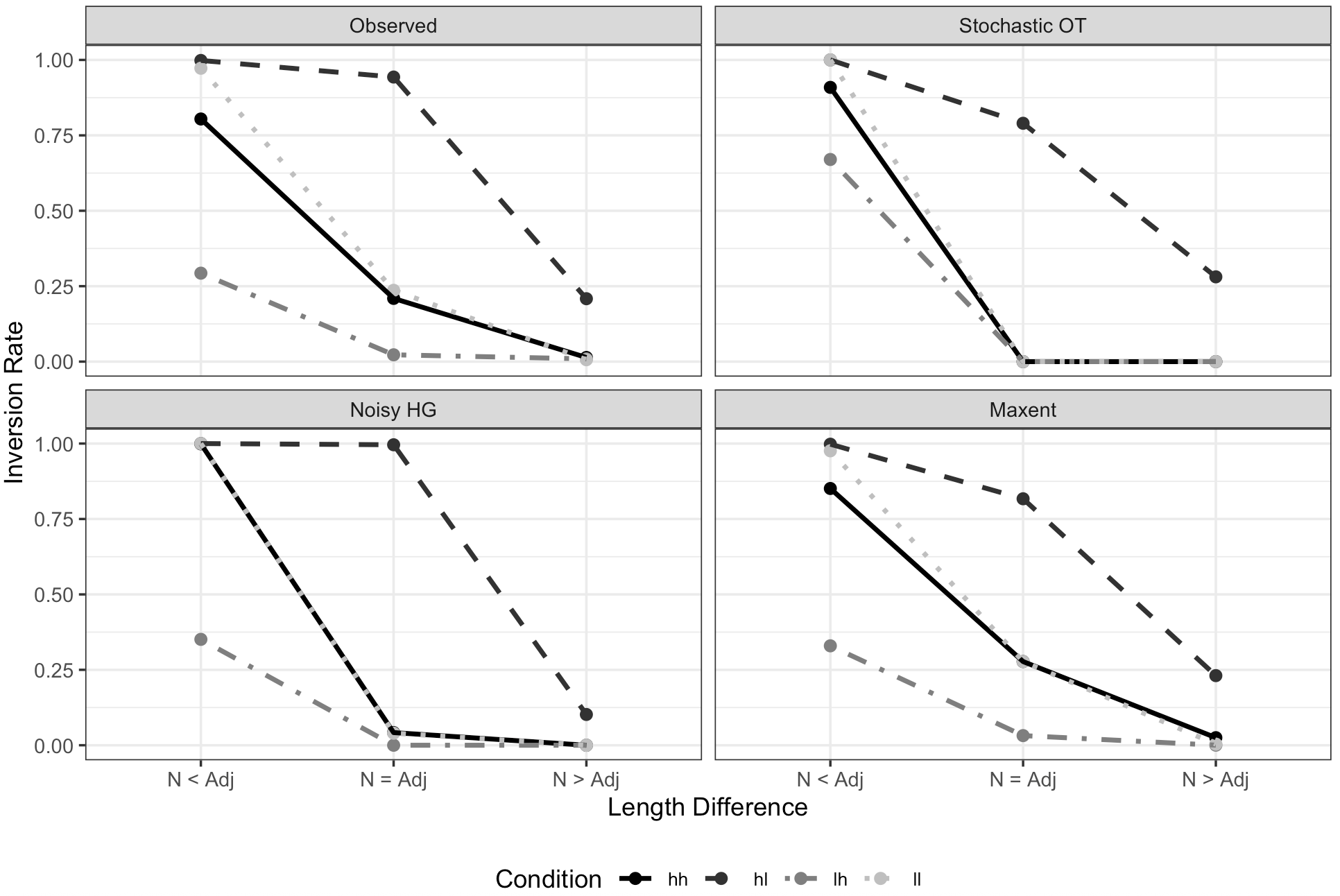
Sample variable data from my dissertation and predictions of three theoretical frameworks. The data show a characteristic family-of-sigmoids shape reminiscent of a wug.
I also investigate how prosodic factors affect the production frequency of line types in poetry. This issue has major implications for the study of variation, given that these effects tend to be gradient and probabilistic rather than categorical and deterministic.
Cumulativity
A unifying theme throughout my research projects is cumulativity in phonology, the combined effect of multiple phonological factors or multiple instances of a single factor on the well-formedness, probability, or acceptability of linguistic structures. For the past two decades, cumulativity has been a testing ground for competing constraint-based frameworks in phonology. My research on natural language prosody and metered verse shows that cumulative interactions are ubiquitous, as predicted by Harmonic Grammar, but not by Optimality Theory.
I am particularly interested in superlinear cumulativity, where the joint contribution of interacting constraints exceeds the sum of their independent contributions. Here’s a nice example of superlinearity from my dissertation:
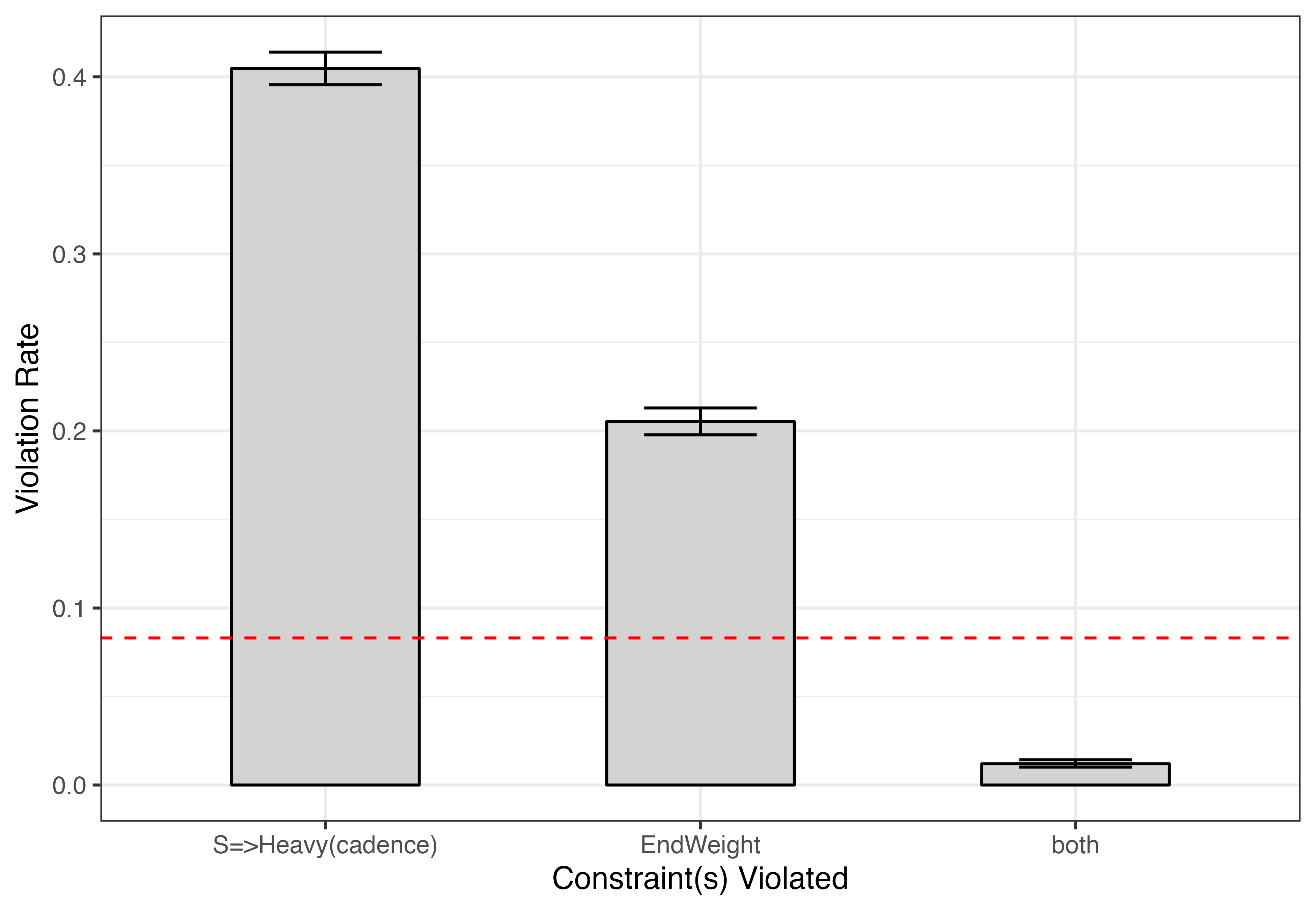
Superlinear cumulativity: the effect of violating both constraints simultaneously is more detrimental than expected given their independent effects; the probability of doubly-violating structures is much lower than expected under the assumption of statistical independence.
Superlinearity poses a challenge for virtually all constraint-based frameworks. It raises the question of whether phonological theory requires interaction terms between factors, known in phonology as constraint conjunctions (Smolensky 2006, The Harmonic Mind). My forthcoming Phonology paper and my dissertation argue, from different perspectives, that conjoined constraints are necessary in both Optimality Theory and Harmonic Grammar. Even when conjunctions are allowed, Harmonic Grammar, especially Maxent as its probabilistic variant, outperforms competing theoretical frameworks.